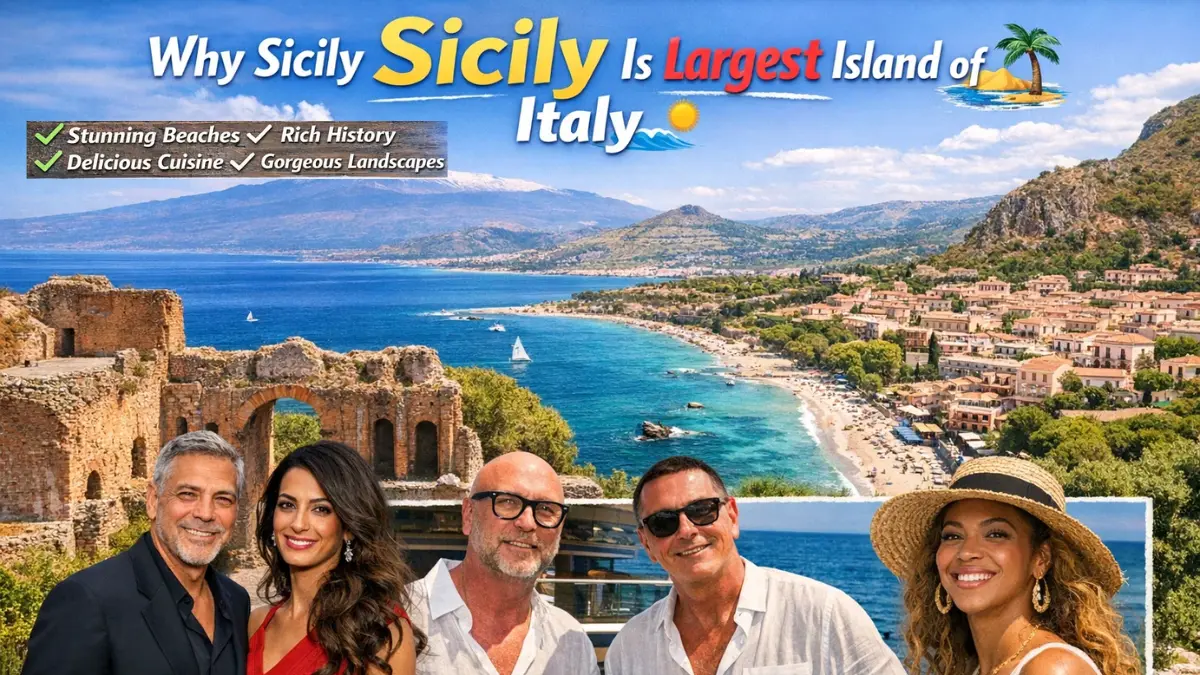
Sicily is not just an island—it is Sicily proudly holds the title of the largest island of Italy 🌍. Rich in history, culture, landscapes, and traditions. Located in the heart of the Mediterranean Sea, this stunning island has played a crucial role in shaping Italy’s past and present. From ancient civilizations and active volcanoes to golden beaches and world-famous cuisine, Sicily stands apart from all other Italian islands.
In this detailed guide, we’ll explore why Sicily is the largest island of Italy, what makes it unique, and why it continues to attract millions of travelers, historians, and culture lovers every year ✨.
🌍 Where Is Sicily Located?

Sicily lies at the southern tip of Italy, separated from the mainland by the Strait of Messina, which is just about 3 kilometers wide at its narrowest point. Despite being so close to mainland Italy, Sicily has developed a distinct identity due to its geography and long, independent history.
Because of its strategic location between Europe, Africa, and the Middle East, Sicily has always been a crossroads of civilizations 🌊.
📏 Why Sicily Is the Largest Island of Italy
The main reason Sicily is called the largest island of Italy is its sheer size and land area.
📐 Sicily by the Numbers
- Total Area: Approx. 25,711 square kilometers
- Population: Over 5 million people
- Coastline Length: About 1,000 kilometers
No other Italian island comes close to this size. Even Sardinia, the second-largest island of Italy, is slightly smaller. Sicily’s massive land area allows it to host mountains, plains, volcanoes, beaches, and major cities—all on one island 🏞️🏖️.
🌋 Mount Etna: A Giant on the Largest Island of Italy

One of the strongest reasons Sicily stands out is Mount Etna, Europe’s highest and most active volcano 🌋.
Why Mount Etna Is Special
- Tallest active volcano in Europe
- A UNESCO World Heritage Site
- Influences soil fertility across Sicily
- Shapes the island’s geography and agriculture
The presence of Mount Etna adds to Sicily’s vast landform variety, making the largest island of Italy even more geographically impressive.
🏛️ A Rich History That Matches Its Size

Sicily’s history is as vast as its land 🏺. Over thousands of years, many civilizations ruled the island, each leaving behind monuments, architecture, and traditions.
Civilizations That Shaped Sicily
- Ancient Greeks
- Romans
- Arabs
- Normans
- Spanish
This blend of cultures makes Sicily unique not just in Italy, but in the entire Mediterranean 🌍.
🏙️ Major Cities on the Largest Island of Italy – Sicily
Sicily, being Italy’s largest island, is home to a number of historically and economically significant cities. Each city has its own unique charm, heritage, and contribution to the island’s importance.
1️⃣ Palermo – The Capital City 🏛️

- Overview: Palermo is the capital of Sicily and its largest city. It’s a vibrant mix of cultures, showcasing Arab, Norman, and Byzantine influences.
- Culture: Known for its historic markets, stunning cathedrals, and theaters like Teatro Massimo, Palermo is Sicily’s cultural heart.
- Economy: Palermo is a commercial and administrative hub, with strong tourism, services, and maritime trade.
- Highlights:
- Palermo Cathedral
- Norman Palace (Palazzo dei Normanni)
- Quattro Canti (baroque square)
2️⃣ Catania – At the Foot of Mount Etna 🌋

- Overview: Catania is Sicily’s second-largest city, located on the eastern coast near the famous Mount Etna volcano.
- Culture: Known for its baroque architecture, lively piazzas, and rich history, Catania blends natural beauty with urban life.
- Significance: The proximity to Mount Etna has influenced its architecture and agriculture. Catania is famous for its citrus orchards and vineyards.
- Highlights:
- Piazza del Duomo
- Catania Cathedral
- Fish Market (La Pescheria)
- Mount Etna excursions
3️⃣ Messina – The Gateway to Mainland Italy 🌉

- Overview: Messina is located in northeastern Sicily, very close to the Italian mainland across the Strait of Messina.
- Strategic Importance: Historically and geographically, Messina has been the gateway between Sicily and mainland Italy, serving as a key port city.
- Culture & Economy: Messina is known for its maritime trade, shipbuilding, and fishing industries. It also hosts impressive religious monuments.
- Highlights:
- Messina Cathedral and Astronomical Clock
- Strait of Messina views
- San Salvatore bell tower
4️⃣ Syracuse – Ancient Greek Heritage 🏺

- Overview: Syracuse, on Sicily’s southeastern coast, was a major power in the ancient Greek world.
- History: Famous for Greek temples, theaters, and ancient ruins, it played a key role in Mediterranean history.
- Culture: The city preserves its ancient architecture alongside modern Italian life. It is a UNESCO World Heritage Site.
- Highlights:
- Greek Theatre of Syracuse
- Archaeological Park of Neapolis
- Ortigia Island (historic city center)
5️⃣ Agrigento – The Valley of the Temples 🏛️

Valley of the Temples archaeological site
Overview: Agrigento is located on the southern coast of Sicily and is world-famous for its ancient Greek ruins.
History & Significance: It was one of the most prominent Greek colonies in Sicily, and the Valley of the Temples is a major archaeological site.
Culture & Tourism: Agrigento attracts tourists worldwide for its well-preserved temples and stunning coastal views.
Highlights:
Temple of Concordia
Temple of Juno
🍝 Food Culture Across Sicily

Size matters when it comes to food too 😋. Sicily’s large land area allows diverse agricultural production.
Famous Sicilian Foods
- Arancini (stuffed rice balls)
- Cannoli (sweet pastry)
- Pasta alla Norma
- Fresh seafood 🐟
- Citrus fruits 🍋
The fertile volcanic soil makes Sicilian food rich in flavor, further enhancing its reputation.
🏖️ Beaches and Coastline of Sicily

With nearly 1,000 km of coastline, Sicily offers some of the most diverse beaches in Italy 🌊.
Types of Beaches You’ll Find
- Sandy beaches
- Rocky cliffs
- Hidden coves
- Clear turquoise waters
This extensive coastline is another reason Sicily dominates as the largest island of Italy.
🌄 Natural Landscapes Beyond Beaches
Sicily isn’t just about beaches and volcanoes. Its large size supports multiple natural environments:
- Rolling hills 🌾
- Vineyards 🍇
- Mountain ranges 🏔️
- Nature reserves 🌿
Few islands in Europe can offer this level of variety.
🏛️ UNESCO World Heritage Sites

Sicily hosts several UNESCO World Heritage Sites, proving its global importance 🌍.
Notable Sites
- Valley of the Temples
- Mount Etna
- Baroque cities of Val di Noto
- Arab-Norman Palermo
Such cultural richness is rarely found on a single island.
🚢 Economic & Strategic Importance
Because it is the largest island of Italy, Sicily plays a major role in:
- Mediterranean trade
- Tourism economy
- Agriculture
- Cultural exchange
Its ports connect Europe with Africa and the Middle East, making Sicily strategically vital.
🌞 Climate Advantage
Sicily enjoys a Mediterranean climate with:
- Hot summers ☀️
- Mild winters
- Long growing seasons
This climate supports agriculture, tourism, and outdoor living year-round.
✨ Why Sicily Feels Like a Country, Not Just an Island
Many travelers say Sicily feels like a separate country—and for good reason 🇮🇹.
- Distinct dialect
- Unique traditions
- Strong regional identity
- Diverse landscapes
Its size allows Sicily to maintain this independence while still being part of Italy.
🏝️ Sicily vs Other Italian Islands
To understand why Sicily dominates, let’s compare it briefly:
- Sicily: Largest island of Italy, diverse landscapes, active volcano
- Sardinia: Second largest, rugged terrain, fewer volcanoes
- Elba: Famous but much smaller
- Capri & Ischia: Beautiful yet tiny in comparison
Sicily’s scale gives it an unmatched diversity that no other Italian island can offer 🌟.
🔑 Key Takeaways: Largest Island of Italy
- Sicily is the largest island of Italy by land area
- Home to Mount Etna, Europe’s most active volcano 🌋
- Rich history shaped by multiple civilizations
- Diverse landscapes, cities, and beaches
- Cultural and economic powerhouse
❓ FAQs: Largest Island of Italy
1. What is the largest island of Italy?
The largest island of Italy is Sicily, covering about 25,711 square kilometers.
2. Is Sicily bigger than Sardinia?
Yes, Sicily is slightly larger than Sardinia, making it Italy’s biggest island.
3. Why is Sicily considered unique?
Sicily is unique due to its size, history, Mount Etna, diverse culture, and landscapes.
4. Is Sicily connected to mainland Italy?
No, Sicily is separated by the Strait of Messina, but ferries and flights connect it easily 🚢✈️.
5. How many people live in Sicily?
Around 5 million people live on the largest island of Italy.
6. Is Mount Etna dangerous?
Mount Etna is active but closely monitored, and eruptions are usually slow and controlled.
7. Is Sicily good for tourists?
Absolutely! Sicily offers beaches, history, food, and nature—all in one destination 🌍.
Also Explore: Sicily Italy’s Largest Mediterranean Island Revealed
🌟 Conclusion
Sicily earns its title as the largest island of Italy not just because of its size, but because of everything it contains within that size 🏝️. From ancient ruins and fiery volcanoes to golden beaches and rich cuisine, Sicily is a land of contrasts and beauty. It is an island that feels limitless—geographically, culturally, and historically.
If you’re looking to understand Italy beyond the mainland, Sicily is the perfect place to start 🇮🇹✨.

I am a luxury travel content specialist with over 9 years of experience covering exclusive luxury resorts, private islands, and elite travel experiences around the world. Through in-depth research and curated insights, my platform helps discerning travelers discover high-end destinations, bespoke stays, and unforgettable escapes designed for comfort, privacy, and elegance.